Liberty
Updated: Nov 7, 2025

The last light has gone out of the world, except
This moonlight lying on the grass like frost
Beyond the brink of the tall elm’s shadow.
It is as if everything else had slept
Many an age, unforgotten and lost
The men that were, the things done, long ago,
All I have thought; and but the moon and I
Live yet and here stand idle over the grave
Where all is buried. Both have liberty
To dream what we could do if we were free
To do some thing we had desired long,
The moon and I. There’s none less free than who
Does nothing and has nothing else to do,
Being free only for what is not to his mind,
And nothing is to his mind. If every hour
Like this one passing that I have spent among
The wiser others when I have forgot
To wonder whether I was free or not,
Were piled before me, and not lost behind,
And I could take and carry them away
I should be rich; or if I had the power
To wipe out every one and not again
Regret, I should be rich to be so poor.
And yet I still am half in love with pain,
With what is imperfect, with both tears and mirth,
With things that have an end, with life and earth,
And this moon that leaves me dark within the door.
Edward Thomas took a couple of months to write Liberty from his original conception in the autumn of 1917. The starting point was one evening in September 1915 shortly after he had arrived at his first military training camp at High Beach (or High Beech as it was known in ET's day) in Epping Forest.

He was standing in the doorway of the King’s Oak Hotel above High Beach looking out. He wrote in a note at the time:
“On grass before Kings Oak 19 ix 15
“The moonlight lies on the grass as white as frost beyond the brink of the tall elms shadow.
(When nothing matters crossed out)
The worst of all is
The worst of all is doing nothing when is nothing to do & you are only free
For what you do not like, & you like nothing.”
He then jotted down “See later”
He went on to write on the opposite page:
“If I could have all such hours in a pile & dip in & take a handful & be rich - or could sweep all away for ever I should be rich to be so poor.”
So two of the main themes of the poem were already very much in his mind that early autumn evening as he looked out from the hotel door.

The 19th September was a Sunday and ET had arrived at the camp on the Friday two days before. He was likely to have had the weekend to settle in, so this Sunday evening would have been his last day before military training was to start in earnest on the following day. The King’s Oak Hotel had been initially where his regiment, the Artists Rifles, was based before moving in the summer into quarters further down the hill at Riggs Retreat, off Wellington Road. He probably had spent time with his new comrades, possibly over a beer if military rules allowed, and was now looking out of the darkened porch at the moonlit scene beyond.

The scene was one of the high points of Epping Forest, an open area looking west towards Waltham Abbey below, and beyond to the horizon where the sun had set some time before, and “the last light had gone out of the world..” The moonlit area, “like frost” beyond the shadow of the elm and the neighbouring road, was an undulating stretch of close cropped grass, known as the Pillow Mounds. These are a series of twenty long curious shaped mounds originally thought to be Iron Age burial graves, but now known to be much later (16th century) man-made warrens for breeding coneys or rabbits. In ET’s day they were still thought to be an ancient burial ground as flints and pottery shards had been found within the mounds.
In the poem everything except the moon and poet/observer is under an enchantment or spell as if in a fairy tale. It suggests looking back at a different, ancient world, “as if everything else has slept/Many an age”, in which an ancient burial site would have been a more significant and integral part of the landscape.

ET was always interested in the ancient monuments within the English landscape, noting tumuli and barrows when he had come across them on his travels. Although he did not mention the Pillow Mounds in his notebooks, the reference of both everything asleep and "the grave where all is buried" in the first part of the poem, strongly suggests he had already heard about or discovered them and knew of their reputed origins.
Later in the poem there is further evidence that he was very aware of the Pillow Mounds before him. He wrote about his regrets piled up in front of him as if they were a hoard dug up from these ancient mounds. Like a treasure trove he wanted to take and carry his regrets from his past away with him. Or conversely like a negative trove, his wealth would come from the discarding of them.
In the penultimate line he came back to what could be another reference to the ancient graves lying in front of him that moonlit evening, that he was half in love.. “With things that have an end, with life and earth”.

So the Pillow Mounds were “the grave/Where all is buried…” and became the third (unstated) player in the poem with the moon and the poet/observer.
The second section of the poem beginning with “if every hour/Like this one passing..” drew together his earlier thoughts he had jotted down about accumulating regrets into a pile.
On 16th November, shortly after his arrival at Hare Hall Camp in Romford, where he was to remain for the next nine months, he had noted:
“To be free is not to know (or to forget) that there is anything you cannot do (if you could)”
In the second half of the poem he mocked this and his earlier ponderings about freedom - and the time spent doing so.
Yet from his letters, freedom was clearly uppermost in his mind as he was thrown into the hard routine and time consuming duties of military training.
He wrote to Walter de la Mare two days before he wrote the poem on 26th November “We have been at a loose end which is not the same as being free.” And to Frost in early December he wrote`: “I don’t want to read anything. On the other hand as soon as I get really free with nothing close before me to do I incline to write. I have written two things (including Liberty) here…”

As Edna Longley noted of the poem “The speaker confronts a paradox: actions that tie one down (joining an army, perhaps) may be liberating whereas too much choice can paralyse the will.”
A year earlier, like Hamlet envying Fortinbras, Thomas had contrasted the attitudes of “the men who are fighting or going to fight” with those of morbid people whom the balance or fusion of mind and body is impossible, and who admire frantically what is impossible to themselves.”
But now he was much more in balance - as he wrote to Robert Frost in November 1915: “I never was so well or in so balanced a mood.”
Later in the month he wrote to Eleanor Farjeon “some of the men are very interesting and altogether days pass easily - a little too easily.” He had written similarly to Walter de la Mare. This contrasted with his early feelings of self-consciousness and melancholy, expressed in the poem, October and in various letters to friends, when he had first arrived and found no kindred spirits at High Beach.

Instead he had now reached an equilibrium that enabled him to appreciate both his comrades and other sublunary, earthy things, warts and all as described in the poem.
In the third last and penultimate lines, the rhyme of mirth and earth had previously been used by him in his second Digging poem where the earth was not just for sowing and planting, but was also a keeper of the past. In Liberty using the same rhyme he was also signifying earth as the keeper of the past but also storing so much more. The twenty Pillow Mounds extending out under the moonlight must have seemed to be capable of being such a vast repository compared to a solitary tumulus or barrow.

He had first rhymed mirth and earth in The Other where he recalled standing at a stile on the way back from East Grinstead to Selsfield House in December 1913, looking out at an evening sky, as he was doing 21 months later in Epping Forest:
“The last light, filled a narrow firth,
Among the clouds. I stood serene,
And with a solemn quiet mirth,
An old inhabitant of earth.”
In Liberty he developed what “an old inhabitant of earth” would feel about the world around him. As Edna Longley noted “An old inhabitant of earth is part of a community defined by an ecological sense of history… “ which he further elucidated in Liberty. The Other's "moments of everlastingness” could also describe his later experience looking out of the Kings Oak’s porch.

Despite his early blacker mood when he first came to High Beach, he was now regarding his life in a much mellower, more accepting mood. In Liberty he seems to have even been remembering more fondly his initial meeting with some of his comrades at High Beach. They became the “Wiser others” of the poem, with whom he spent an hour before his solitary watch outside the hotel: wiser presumably because he felt they lived life in the moment, not looking back with regret or forward with anxiety as he did.
These more positive memories than his initial impressions predominated two months later when writing Liberty, the third of his autumn poems. They overturned the melancholy and negative views he had held when starting his military training, thus proving his prediction in his first autumn poem October, written shortly after arriving at High Beach:
“Some day I shall think this a happy day,
And this mood by the name of melancholy
Shall no more blackened and obscured be.”
Walk
The World War One camp for the Artists Rifles at High Beach was originally based at the King's Oak Hotel, but by the the autumn of 1915 there was an encampment around Riggs Retreat on Wellington Hill where ET was quartered for a few weeks before going to Hare Hall Camp in Romford.

The King's Oak is still a popular pub at the top of Epping Forest. To the west is the open common of the Pillow Mounds with its views down to Waltham Abbey. A walk could start at the pub where, sadly, the elm has long since gone. Across the road from the pub are the Pillow Mounds, which as mentioned above, were probably warrens specially constructed in the 16th century for breeding rabbits for the table - though excavation of flints and pottery shards suggest a much older usage. In ET’s time the accepted wisdom would have been that these mounds were ancient burial grounds.
The Pillow Mounds are much as when ET would have seen them - grassy, close cropped and undulating. Their undulations have been worn down somewhat by the number of visitors and their footsteps over the last century. They can be walked around in a few minutes.
The location of Riggs Retreat can be found down Wellington Hill on the left. It was originally a place for the purveyance of non-alcoholic refreshments.
The joy of walking through Epping Forest is that you can walk unconfined as ET must have done in his occasional free time. Around the margins one can encounter sections of private land, but otherwise the forest continues, only interrupted by a few busy roads whose noise creates a wider borderland for the walker to navigate round.
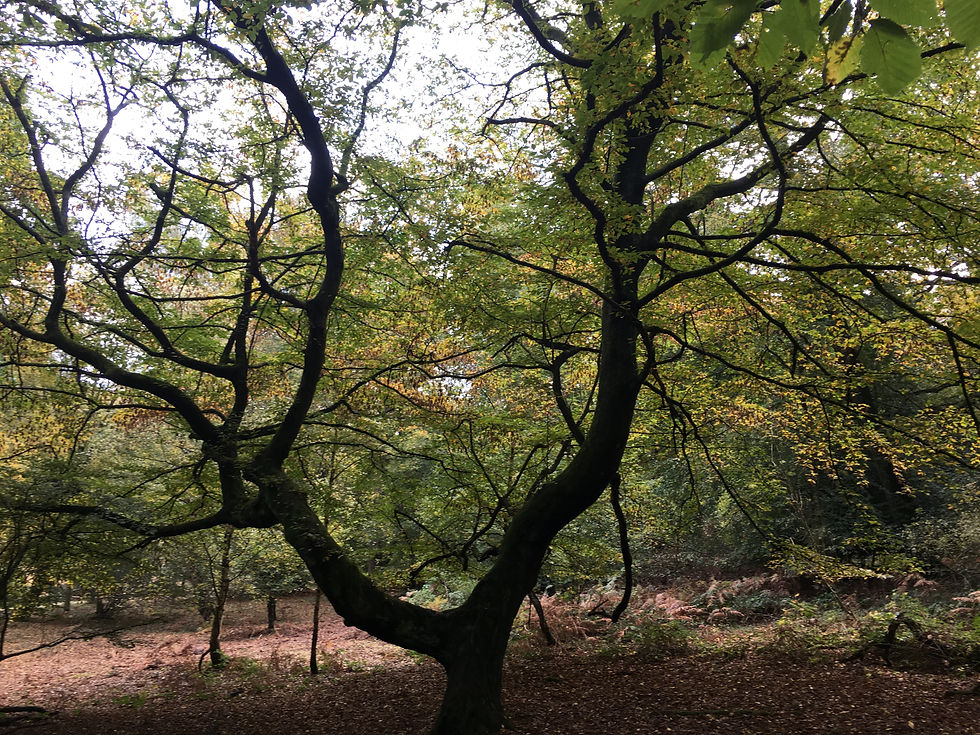
A longer walk is best done as a wander round the big trees - beech, oak and hornbeam in particular that dominate the landscape. Though there are few far reaching views, the Forest has a sense of space under the beeches and hornbeams. Many of them have been pollarded centuries ago and have developed their own completely individual character. Under their canopy there is a lack of underwood and an absence of thrusting competitors. So there are ever-enticing vistas - into dappled glades where the sculpted trunks of a tree stand comfortable and aloof with further glades glimpsed or screened by holly; a brown leaf-strewn stream meandering through bog and under alders and willows then between stately beeches and hornbeams; a sudden patch of bright green grass or a tree with blazing autumnal leaves; then up to more open savannah-like country on rising ground with a few oaks, many small birch, and gorse, bracken and bramble.

More on walking round Epping Forest can be found on the post for ET’s poem, October, one of the earliest posts on this website. A link to walks on Epping Forest can be found in the Acknowledgements section below.

Acknowledgements
Edward Thomas Field Note Books copyright Henry W. and Albert A. Berg Collection, New York.
Transcription of the Edward Thomas Field Note Books quoted in this and other posts are available at the Edward Thomas Centre in the Petersfield Museum.
I have also quoted gratefully from:
Edward Thomas The Annotated Collected Poems edited by Edna Longley.
Elected Friends Robert Frost & Edward Thomas to one another
Poet to Poet: Edward Thomas’s Letters to Walter de la Mare
Eleanor Farjeon The Last Four Years
The City of London corporation manages Epping Forest and has a good list of walks to be enjoyed:
There are also numerous walk suggestions on the internet - though as suggested the best way to explore Epping Forest is to follow your nose!


Comments