February Afternoon
Updated: Mar 17

Men heard this roar of parleying starlings, saw,
A thousand years ago even as now,
Black rooks with white gulls following the plough
So that the first are last until the caw
Commands that last are first again, - a law
Which was of old when one, like me, dreamed how
A thousand years might dust lie on his brow
Yet thus would birds do between hedge and shaw.
Time swims before me, making as a day
A thousand years, while the broad ploughland oak
Roars mill-like and men strike and bear the stroke
Of war as ever, audacious or resigned,
And God still sits aloft in the array
That we have wrought him, stone-deaf and stone-blind.
Edward Thomas wrote February Afternoon while recovering from an illness at his parents’ house in London during his military training. Written on 7th and 8th February 1916, he was to go home to Steep for a few days further recuperation before going back to military camp at Romford, Essex.

He was remembering in the first lines the field behind his house, Yew Tree Cottage, in Steep. He had seen starlings congregate there a year before on a still warm afternoon in early February. He described the sky as being mainly blue “were it was not softened by haziness & hardly any wind blows.” He heard the woodpecker’s laugh and “starlings perch singly in hedge & talk & chatter & whistle with heads up making a sort of spiky beard under beaks, bubbling throat on damson twigs; thrushes loud. Sometimes dozens of starlings separately on hedge & in oaks of meadow behind are talking at same time - the sweetest voiced democratic crowd imaginable.” He liked the last thought so much that he reworked it into “The sweetest democracy imaginable”.
Since his arrival at Yew Tree Cottage he had seen the starlings congregate on a number of occasions, normally in the autumn to peck the damsons in the hedgerow around the cottage garden. On this February day they had also taken over the oak in the meadow behind Yew Tree Cottage and he recalled the crowd fondly in his poem.

In the poem he was also remembering a more ancient landscape which he had visited in May of 1912 - Avebury in Wiltshire. Here he had seen the rooks (but no gulls) following the plough. He had noted:
“Rooks swarming after 3 ploughs ploughing (2 horses to plough) in misty morning -
each last rook is first in its turn & so eager are they to be first many grits must survive - a combined change of places & some change over to another plough.”

In another note the previous year, towards the end of November 1911, he had seen gulls do something similar in the far west of Pembrokeshire
“Gulls after plough - last continually fly to be first & higher for? they hardly ever let their wings really fold at rest as they alight, move over rough clods & rise again - very white in sun, bodies like snow.”
As is sometimes the case with sources of inspiration for ET’s poems, there might be some combining of memories - and he had a number of notes about rooks and gulls flocking together at different points of the year, often over ploughed land.
Yet there are a number of other reasons besides the rooks, to think that ET was remembering specifically his visit toAvebury when writing the later poem.

He was walking along the Ridgeway in May 1912 from Swindon and the first night he spent in Avebury. He had already noticed a number of sarsen stones close to the path. When he rested on the top, two miles from Avebury, he could look down on a tumulus upon the down above West Monkton, with “tufty” firs at both ends and others fainter beyond. He thought it looked like a desert palm scene or a Japanese print with its “simple, dainty wisp-like, half conventionally wild elegiac sentiment”. Seeing another tumulus with several clumps closer to Avebury, he noted “This is holy ground. It looks hieratic and shorn with all its solitude.” In the next note but one he describes Avebury as a “ghostly place” but the reason for this was somewhat bizarrely that his eyelashes hanging down against the sun had created a sense of a “pale presence”!
The combination of antiquity and holiness he found in Avebury fascinated him and became the main themes for his subsequent descriptions about Avebury which extend for several pages.

So he was speculating on the origins of Jugglers Lane, on the way from Avebury to Calne, linking it to the story of the Medieval dancer in Jusserand’s retelling of “The Tumbler of our Lady”. He spent time at Avebury church which he noted was “very ancient looking”. It was "much restored but with many quaint ancient things, oblique spyholes into chancel from aisles, a little inset in wall with a drain hole out of it (in which was an empty head of wheat).” In fact compared with the stones that surrounded it, the church was a comparative newcomer, being only around 1500 years old.
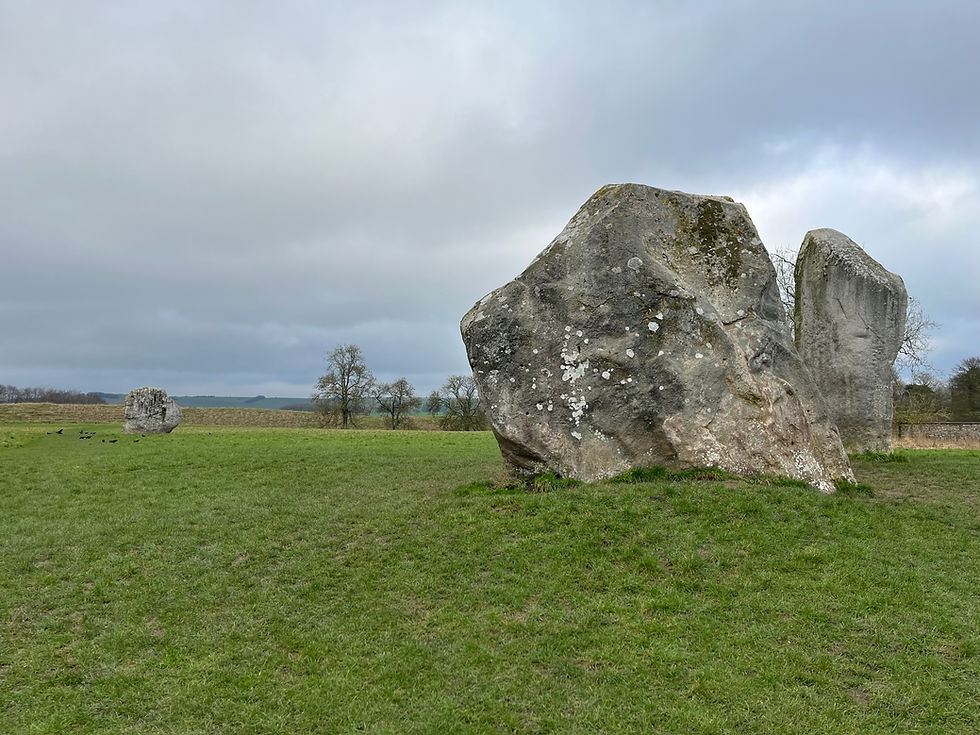
The most impressive sight at Avebury in ET’s view were two long stones, “huge and formless & dark” in a hedgeless roadside field beyond the main centre of Avebury, to the west towards Beckhampton. It was here he saw the rooks following the plough. On the other side of the road there was also a huge excavated tumulus which caught his eye. He noted the array of other stones throughout Avebury describing them as like bulbous snowmen, “only they were 3000 years old”. Silbury Hill he was less impressed with, describing it as “like the tip from a mine etc & could have been made yesterday by Mr Carnegie. It is just gauche neither rude nor graceful.”

However overall he was much taken with Avebury - it was “a village full of turnings &
surprises & confusions” with its thatched farm yards, cart lodges and decent small stone houses. Later he exclaimed “I never saw such a village for paths etc round about & all over a space of about a mile - a good book might be written of these paths alone, a very good book.”
But he kept on coming back to religion. The crosses that marked the stones that were missing might have been “made on purpose to exorcise the Druid ghosts.” Just before entering Avebury he had come across children picking cowslips “bending and unbending”. One was singing a hymn like song which put him in mind of Chaucer’s The Prioress Tale. This tale, about a young boy martyred by the Jews for singing a hymn as he passed their ghetto, was a tale of sanctimoniousness and anti-semitism which would have been a popular subject in the Middle Ages. By Thomas’s day, as in our own, the tale would have exemplified the excesses and bigotry of the church.
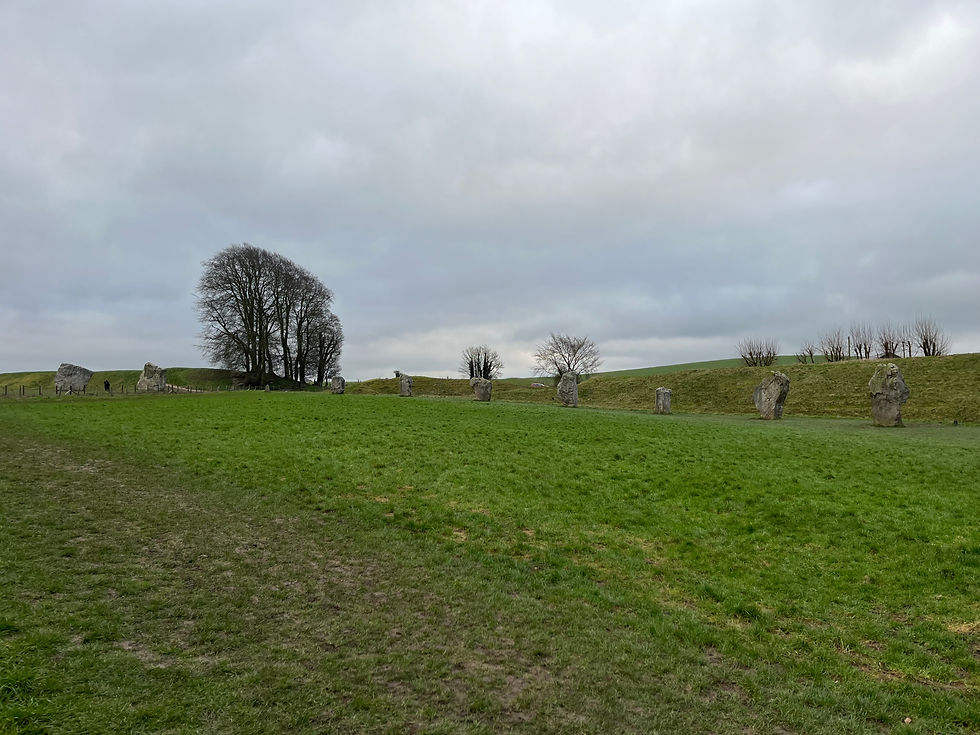
The two stones of Longstone field which he had found to be the most impressive part of Avebury are known as Adam and Eve. They may have been part of an avenue of stones, now buried or broken up for other use, going from Beckhampton to Avebury in a similar way to the West Kennet Avenue from Overton Hill to Avebury on the other side of the village. The field is nowadays unploughed but there are still rooks, presumably descendants of those he saw, congregating on the ground and flying up when disturbed. By mid February they are also gathering in rookeries in trees by the church..

So when he came to write the poem he could have been remembering not just the rooks but other aspects of this ancient and hieratic landscape in which “Time swims” before him, “making as a day,/ A thousand years.”
He had been to Avebury before. He had spent several weeks in Wiltshire in 1908, researching for his life of Richard Jefferies, exploring the Wiltshire countryside with Helen, his wife. There are few notes about the trip and none about Avebury specifically but he did write a passage about Avebury in the subsequent book:
“If the Ridgeway is left on Avebury Down, another grassy track leads into Avebury; and most pleasant is the descent among the sarsens that rest on turf blue with sheep’s bit or rosy with rest-harrow. Jefferies knew Avebury, through love of the down ways and through his early archaeological curiosity. What they worshipped at Avebury temple no-one knows, but the human mind is still fertile in fantasy and ferocity - if it no longer draws blood - when it worships between walls. To me the sycamores that gloom at the entrance to the temple are more divine.”

He wrote of the sycamores by the church on his later visit:
“ 3 very grand sycamores on North with very open work of about 3 great spreading limbs each & pendant ends to branches - an elder rooted in fork of largest. Others on East, very good - not too near church.”
In the poem ET’s starting point was this continuity of nature and its immutable laws - the starlings congregating in an oak tree and the rooks and gulls following the plough. His mind then turned to an immutable law of man, the propensity of men to fight whether in current battles raging on the Western Front or more ancient combat with sword and shield as described in the poem. In his notebook he had speculated whether the ditches and walls of Avebury were primarily defensive structures, or were they also created as arenas for gladiators?
And he then turned to another immutable law of man - the setting up of gods and their symbols, whether Druidical stones or effigies in churches and God “still sitting aloft in his array.” Unlike nature, God and religious symbols, although as impressive as Avebury Church or as mysterious as the stones of Adam and Eve, were unresponsive, “stone-deaf and stone-blind”, even at man’s darkest times, certainly to an agnostic such as ET.
The long historic perspective of the poem on religion, war and nature was very much in line with what had intrigued and inspired him about Avebury, and then overlaid by the war now raging. In his notebook of his visit, as well as noting the historic and religious sites, he also observed round every corner the abundant natural world, including the rooks following the plough.
The anti-religious feeling of the poem may have been heightened as he was convalescing at his parents house in close proximity to his father, whose non-conformist religious convictions ET fundamentally disagreed with. (During this stay he was also to write his poem I may come near to loving you which he addressed to his father, but never posted.)
Avebury remained a place he remembered fondly. He returned once in June 1915 with his old friend, Jesse Berridge, a rector from Essex. ET had suggested specifically going to Avebury on a bicycle ride. He had written to Jesse on 1st June that he hoped to finish writing his life of Marlborough in 3 weeks (a task he was not enjoying) and then would be free to meet up with him:
“A ride would clear my head best I think, if it suits you. We could go to Avebury & up round. I don’t know how many days you will spare.”
In fact the bicycle tour with Jesse was extended via Southampton and Salisbury and then from Avebury on to Malmesbury. ET then went on to Gloucester on his own where he met up with John Haines and biked with him on to May Hill (where he wrote his poem, Words) and then headed up to Coventry alone before returning home. He made only occasional notes on this bike ride, with none about Avebury. Was Avebury, the most ancient religious site in England, somewhere he wanted to show Jesse specifically, a man of the cloth?
Nine months later while writing the poem, Avebury must have felt a very distant memory after his immersion in military training. It was somewhere he might never see again…. In fact he never did. But February Afternoon contained the traces of the impact this ancient religious place had had on him.
It also continues to have an enduring impact on his memory. When twenty years after his death, the organisers were seeking an appropriate memorial to place on his beloved Shoulder of Mutton Hill they approached Alexander Keiller, the marmalade heir and owner and champion of Avebury. As a result a sarsen stone was removed from its Wiltshire home and brought to Hampshire and set up on the hillside overlooking the South Downs, a permanent connection between two places he especially loved.

A walk
There are many excellent perambulations round Avebury taking in the numerous sarsen stones, walls and ditches, and the church and other buildings. The National Trust has a good guide. The stones of Adam and Eve, which ET found so impressive, still stand in the field between Avebury and Beckhampton, with Windmill Hill to the north. They can be reached along Nash Road from Avebury Trusloe and you can walk around them. On the day I visited in early February there were rooks and jackdaws congregating on the unploughed field, as well as in rookeries by the church.
In Steep, there is also a walk along a path whence you can see the oaks in the field behind Yew Tree Cottage where ET saw the starlings "parleying". A full description of the walk which was one of the ways he went up to his study can be found in the post on his poem, April.

Acknowledgements
Edward Thomas Field Note Books copyright Henry W. and Albert A. Berg Collection, New York.
Transcription of the Edward Thomas Field Note Books quoted in this and other posts are available at the Edward Thomas Centre in the Petersfield Museum.
I have also quoted gratefully from:
Edward Thomas’s Richard Jefferies
Edward Thomas’s Letters to Jesse Berridge
My thanks as ever to Ben Mackay for editorial support


Comments