Home (2)

Often had I gone this way before:
But now it seemed I never could be
And never had been anywhere else;
‘Twas home; one nationality
We had, I and the birds that sang,
One memory.
They welcomed me. I had come back
That eve somehow from somewhere far:
The April mist, the chill, the calm,
Meant the same thing familiar
And pleasant to us, and strange too,
Yet with no bar.
The thrush on the oaktop in the lane
Sang his last song, or last but one;
And as he ended, on the elm
Another had but just begun
His last; they knew no more than I
The day was done.
Then past his dark white cottage front
A labourer went along, his tread
Slow, half with weariness, half with ease;
And, through the silence, from his shed
The sound of sawing rounded all
That silence said.
Edward Thomas wrote the second poem he entitled Home in April 1915. It came directly from an experience one evening earlier in the month which he had written down in his field notebook:
“Evening of misty stillness after drizzly day - last thrushes on oaks - the man goes by a dark white cottage front to thatched wood lodge & presently begins sawing & birds are all still.” (April 12th 1915)

He was mainly at home in Hampshire around this time, beginning on his latest commission, a biography of the Duke of Marlborough, a suitable project for the martial times but one he was already regretting. Apart from the occasional trip to London for research it was to keep him at home for the next two months.
During this time his routine would be to go up to the study in the morning, light the fire and start researching or writing the book - often being waylaid by his latest poem - before returning to Yew Tree Cottage for lunch. In the afternoon he would go back to his study for a few hours to write and read.

His note on April 12th mentioned it had been a drizzly day followed by a misty still evening, - suggesting that as usual he had been keeping an eye on the local weather in his study and that he had not returned from somewhere far away. April 12th 1915 was a Monday - and he had been up in town the previous week at the British Library beginning his research on Marlborough - so it seems unlikely that he was returning from London.
So his reference in the poem of coming back from far suggests, rather than a physical journey, that he had either begun work on Marlborough and his campaigns in his study - hence his mind was faraway both in geography and time. Earlier in the month he had also written his epic poem of England folk history, Lob, and may have been revising that, taking him back to his favourite county, Wiltshire, and his childhood visits there and far further back into English folk history.
In any event during his time in the study, whether researching or working on his life of Marlborough, reworking a poem or considering his future options, he was not present in the moment in the way he was with the birds under the oak trees as he walked home.

So where were these oak trees?
There are a number of clues as to the whereabouts of his encounter.with the birds that drizzly April evening, besides the oak trees. It was a route he often used, close to his home in Steep - where besides oaks there was an elm, and a dark white cottage lived in by a labourer and a thatched wood shed close by.
ET took a number of different routes between his study and home. The most straightforward was walking up the road of Stoner Hill but he would also go the cross-country route along the path across the fields behind Yew Tree Cottage and then up the Hangers via Ludcombe. Occasionally he would detour up or down his favourite hill, the Shoulder of Mutton coming back via the old Steep Mill race and Mill Lane. Or he might go further along Cockshott Lane from his study to Wheatham Hill and then back home via Steep Marsh in a big loop.
The only houses that he passed on his regular routes, lived in by those who he would describe as labourers, would have been those at the bottom of Stoner Hill or Ludcombe and one or two neighbouring houses in Church Road in Steep.

However the thatched wood lodge would suggest a different location. This was a rare sight in this part of Hampshire. The only one recorded in Steep is a thatched store which had been built in 1910 in the gardens of Little Hawsted further along Church Road from Yew Tree Cottage towards the church, just opposite the entrance to Bedales School. The shed had been constructed probably by Geoffrey Lupton who had also built the Red House for the Thomases, their second house in Hampshire. Lupton had also helped construct a little before the shed, Row Cottage which was to accommodate the gardener for Little Hawsted. The bigger house had been built in 1905, and was lived in by the Powells, a senior Bedales master and his family. Powell had commissioned his brother, a well known Arts and Crafts architect to design the house, who was also involved in the design of Row Cottage with Lupton. In the garden of Row Cottage Lupton seems to have built some cob walls as an experiment prior to constructing the apple lodge.

The setting of the two houses and the shed would have been even more open from the road than it is today with easy access from Row Cottage for the gardener to Little Hawsted and its garden. One can imagine the gardener walking across to the thatched shed a hundred yards or so away at the end of his day.
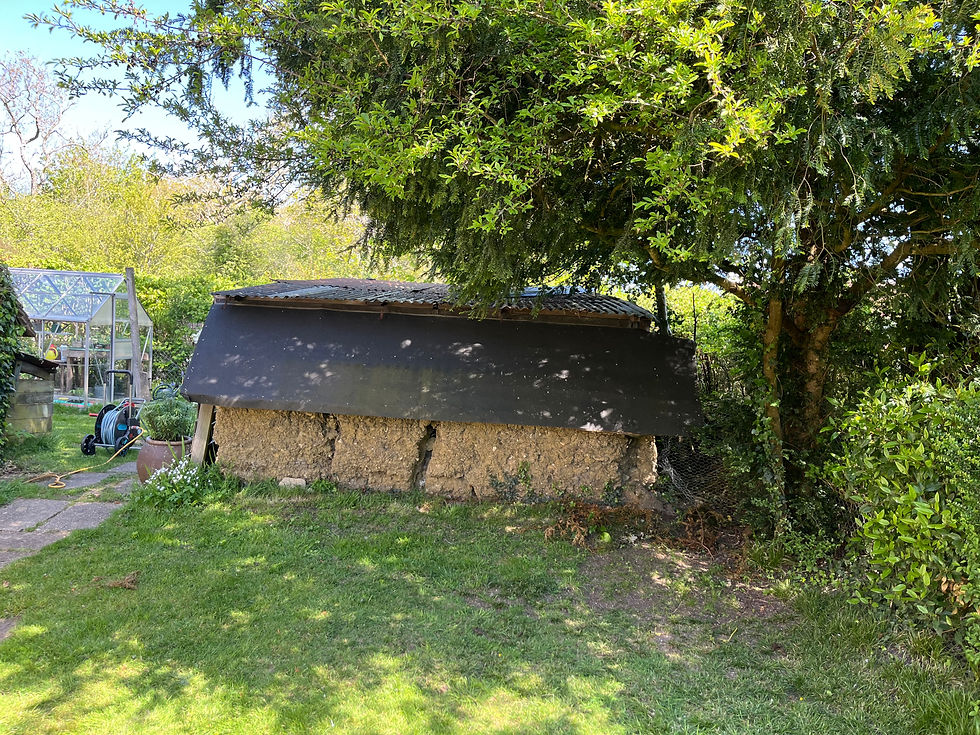
The thatched shed was described as an apple store with its thick cob walls providing an even temperature for storage but it could also have been used for wood.

Row Cottage was a simple arts and crafts cottage with a dominant mansard tiled roof - in between were brickwork and wood frames that were a dark white as in Edward Thomas’s poem and notebook entry. The chimney was also white. The cottage was described by Pevsner thus “Built by Powell for the gardener, with a mansard roof descending almost to the ground, so that the eaves are at hand height. L- plan with the entrance in the angle. Interior crafted by Geoffrey Lupton.”
DJ Pendery goes into more detail: “Several years after the Powells were established at Little Hawsted they needed a gardener and a cottage had to be provided..In the corner of the site was a copse and it was here, close to Church Road, that Alfred Powell designed the new gardener’s cottage to be built by Geoffrey Lupton….. Completed in 1911, Row Cottage was in many ways quite similar to Little Hawsted, but benefited from being a smaller undertaking from the outset. Being amongst trees there were no significant views of the Hangers and so Powell made the most of the southerly aspect, as well as relating to the lane more satisfactorily than at Little Hawsted. The planning was now concise, without appearing constrained.... Powell created a unique cottage, with surely the ultimate mansard roof. The concise planning came about because Powell used an L-shaped plan for the three-up, three-down cottage. By locating the front door, hall and staircase in the angle, each room could be reached with the minimal of circulation space... The main structural timbers were oak..the finely proportioned window frames were oak too as were the substantial oak doors with Ernest Gimson’s ironmongery...”
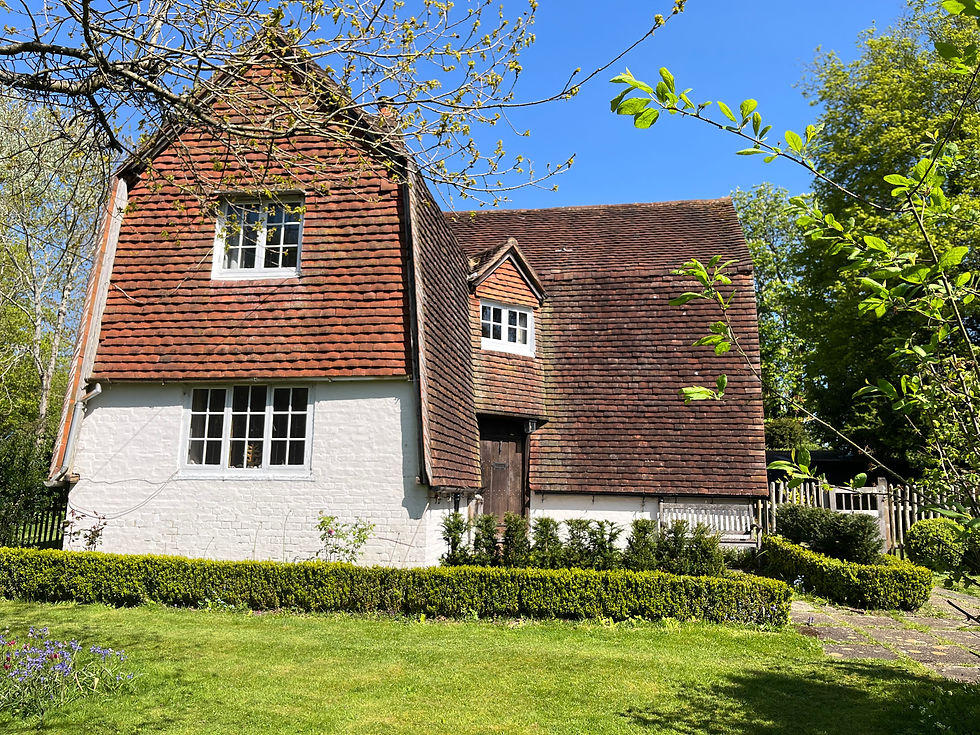
In the garden can still be seen the experimental “pis(e) de terre”, a rammed earth wall on either side of the privy, built by Lupton, probably as preliminary to the construction of the apple store next door. Pevsner described this thatched apple store as “a picturesque delight.”
Row is a Sussex name for a copse and is a reminder that the houses on this side of Church Road were built on the margins of Northfield Wood. Northfield Wood was and is a home for many ancient oak trees. There are still several along the road which would have been large even in ET’s day.
All of this would suggest that ET was passing the garden of Little Hawsted with its thatched shed, having experienced the thrushes last songs in the oaks on either side of Church Road.
This was not on his natural way home although he might have cut through Northfield Wood from Mill Lane for a change and to extend the walk while the daylight lingered later into the April evening. Or if he had done a more extensive walk to Wheatham Hill, he would have come back by Steep Marsh and Steep church and along Church Road. There could have been other reasons for passing. He could have been visiting Bedales, where two of his children were still at school and Helen taught. It would also have been an alternative route into Petersfield and the station along the footpath to Tilmore Road, as well as being the way to Steep church (although he rarely visited it) and the Harrow Inn and the village of Sheet and other points east. So he could well say “Oft had I come this way before”.
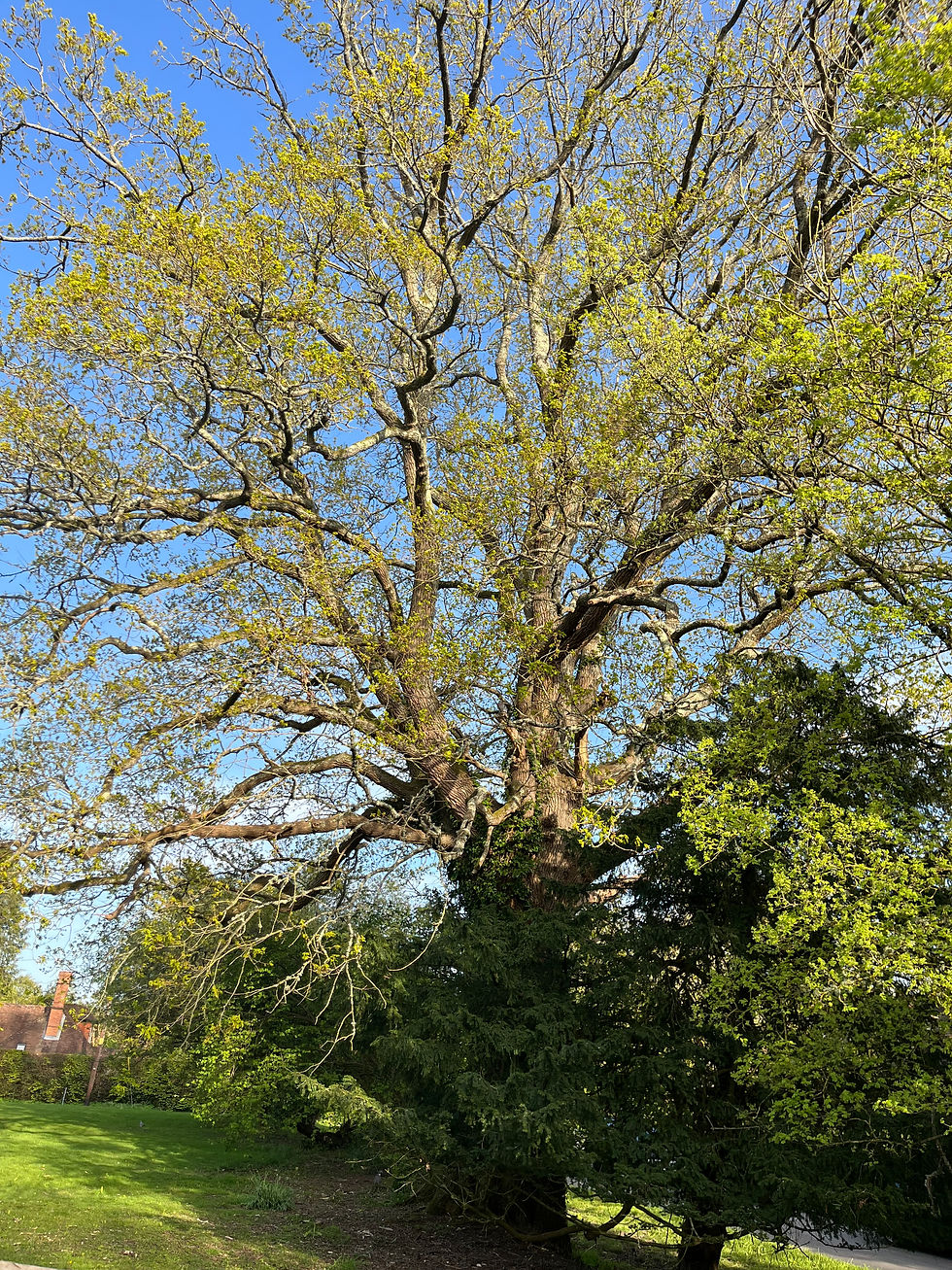
Reading this back I feel I have made a number of assumptions on quite sketchy evidence. However if you walk along Church Road, you will see just opposite Bedales School entrance, Little Hawsted with its thatched apple store just behind it on the right. On the house’s left is Row Cottage. Beside it is an old oak tree and other occasional lesser trees which provides the only boundary between the road and its garden. In ET’s day this would have been even more open, though the oak would have been there, maybe with some companions. So one can see that he would have easily been able to observe from the road the perambulation of the labourer to the thatched shed from Row Cottage, past Little Hawsted. No other thatched shed is known to have existed in the vicinity, so on that basis the gardener of Row Cottage and Little Hawsted’s apple store are the most likely candidates for ET’s encounter that April evening, a place he would had passed often for one reason or another.

He would of course have been aware that Lupton and Powell had been involved in the planning and construction both of his second home, The Red House and of Little Hawsted, Row Cottage and the apple store, with their high level of craftsmanship. Row Cottage’s framework of oak and elm wood were also from the trees where the thrushes were so at home. A couple of hundred yards further on was his own home - Yew Tree Cottage. So the associations with home may well have been proliferating in his mind.

Acknowledgements
Edward Thomas Field Note Books copyright Henry W. and Albert A. Berg Collection, New York.
Transcriptions of the Edward Thomas Field Note Books quoted in this and other posts are available at the Edward Thomas Centre in the Petersfield Museum.
I have quoted with gratitude from the Steep Buildings and Monuments 2012 publication about Row Cottage. Little Hawsted and its apple store.
Pevsner - The Buildings of England Hampshire: Winchester and the North - Michael
Bullen, John Croak, Rodney Hubbuck and Nikolaus Pevsner, Yale University Press
2010.
Pendery, D.J. - Nature’s Own Textures, A dissertation submitted towards a Master of
Arts in Architecture, University of Sheffield, 1989, Bedales Memorial Library
My thanks to Shannon Askew for allowing me access to the wonderful Row Cottage, letting me to use photographs of her house and garden and for her helpful guidance and insights.
And thanks to Fran Box for once again helping illuminate for me the history of Steep during ET's time with her unique knowledge.
Photograph credits - Steep Buildings and Monuments, Women and Home (March 1967)
And as ever thanks to Ben Mackay for editorial support.


Comments