The Mill-Water

Only the sound remains
Of the old mill;
Gone is the wheel;
On the prone roof and walls the nettle reigns.
Water that toils no more
Dangles white locks
And, falling, mocks
The music of the mill-wheel’s busy roar.
Pretty to see, by day
Its sound is naught
Compared with thought
And talk and noise of labour and of play.
Night makes the difference.
In calm moonlight,
Gloom infinite,
The sound comes surging in upon the sense:
Solitude, company, -
When it is night, -
Grief or delight
By it must haunted or concluded be.
Often the silentness
Has but this one
Companion;
Wherever one creeps in the other is:
Sometimes a thought is drowned
By it, sometimes
Out of it climbs;
All thoughts begin or end upon this sound,
Only the idle foam
Of water falling
Changelessly calling,
Where once men had a work-place and a home.
Edward Thomas wrote The Mill-Water in July 1915, shortly after he had been accepted for military training with the Artists Rifles aged 37. With Aspens and Two Houses, it was one of several poems of farewell to Steep, before his military training started in Essex and probably going to fight in France. He had lived at Steep for nearly nine years and, though his family would remain there for the time being, his own centre of gravity was shifting.
In The Mill-Water he described the impact and resonance of the old Mill fall in the village. It was a sound that could be heard all over the parish in the right conditions. The year before he wrote the poem he had written probably in his garden at his house, Yew Tree Cottage, in Church Road:
“14.v.14 Steep -
Night sounds - dull soft roar of Steep Mill fall, motors a mile off & the nightingale & owls halloo in Hangers 1/2 mile off.”
A couple of weeks later he noted when walking past the fall:
“Stream where it runs through narrow roadside channel by Steep Mill sounds like a number of distant sheep bells.”
In other earlier notes he heard Ashford stream, and almost certainly the sound of the mill water, from the top of Stoner Hill and the Shoulder of Mutton, on still evenings.

In his final notebook written during 1915, he wrote a note about the effect the sound of the fall could have on those listening, a precursor to the poem, where he was to expand and round out these earlier thoughts:
“Mill fall sound - heard by those alone who are thinking & stop suddenly - & by those who watch long - so that they seem to feel with all whoever listened to it when mill was there.”
In much earlier notebooks he also included brief notes for possible subjects of his writing.
In one he jotted down two that were to become separate poems:
“Scene
Ruined mill
Sedgewarblers”
In another he wrote:
“The sound of streams inaudible by day.”
In another at the end of a lyrical passage:
“The singing bird dreams on gate
The bracken frond on the air
The white house on this hill is rapt
in a dream.
Water falling hear (sic)”
So he was considering the Mill Water as a subject from early in his time at Steep, when they lived at Berryfield Cottage under Ashford Hangers. Their first house was under a 1/4 of a mile from Steep Mill by footpath which he and his family would have walked regularly on their way to their school at Bedales, Steep village and Petersfield. Steep Mill, which had been a corn mill, had closed a few years before. The mill had been dismantled in the winter of 1906, shortly before they arrived, like many others about that time, made unviable with the advent of cheaper electricity. The last miller, William Waters and his family, probably tenants, had left the mill some years before. In ET’s day Waters farmed at Dunhurst Farm on the road into Petersfield, and he remained the local corn merchant, so ET would have known the family and their involvement with the mill.

Of the old material from the dismantled mill, some of the remains, including the oak beams, were used to build Mill Cottage the year after the Mill was taken down. Nothing remained of the Mill itself except some outbuildings and the fall.
The fall had made an immediate impact on him as he described in one of his earlier notebooks at Steep: “Sounding smoke of white cataract”.
Immediately below Steep Mill was Roke farm through which Ashford stream flowed. It was farmed by another farming family, the Duddys, who were later to build Oakhurst Farm.
In May 1908 ET noted:
“Living beauty of clear sunlit swift stream rippling over dark tresses & white flowers with hard crystal surface over big stones & round a huge projected ash base with cuckoo flowers by Duddy’s cowsheds.”

The mill fall and its immediate surroundings was, and is, a beautiful place to which ET was much drawn. The stream that fed the mill fall, Ashford Stream, rose under a mile away under Ashford Hangers in Ludcombe Bottom, flowing through Ludcombe Pond and then into the grounds of Ashford Manor. Curving round the slope below Berryfield, the stream then widened into what had been two large dammed Mill ponds above the Old Mill House and the Mill race. It looks from the map of 1908/10 as if these ponds had already largely disappeared, overtaken by vegetation with side channels silted up.
Ashford Stream’s strong volume is collected within a mile of its source in Ludcombe Bottom, leading to the “tempestuous sixteen-foot fall of Steep Mill”. As WM Whiteman explained in Edward Thomas Country this is “ due to the acute Vee of the re-entrant which, cutting deep into the edge of the plateau (above Ashford Hangers) , drains a large area of the chalk mass. It runs fast. Aptly the Old English, before the Conquest, called the Ashford Stream the Ludburn or Loudbourne.”

From his earliest days at Steep, Thomas loved Ashford Stream or the Ludcombe, as he often described it. He wrote in May 1908 a note entitled “Ashford Stream”
“Water glitters - afar, close by it is enmeshed, moving like honeycomb, the garden warbler sings, the stateliest tall horse chestnut holds up its flowers, the trout darts - its grey seeming a temporary densification of the water - on the banks are woodruff, forget me not & bugle & the sedges have the heavy green heads of seed.
"Stream seems to gather itself together & plunge where it narrows to pass bridge.”
Here he was probably describing the upper stream between Ludcombe pond and Ashford Manor on Ashford Lane.
More often he noted the sound of the stream. On a November evening the year before he wrote:
“Owls shouting into the woods, echo of Ashford valley, pitch dark, wet after a day of
rain, still after a hurricane, with the little undertone of the falling stream the only other sound & that being continuous coexists with rather than breaks the silence which it is the joy of the Owl to shatter, to honeycomb.”
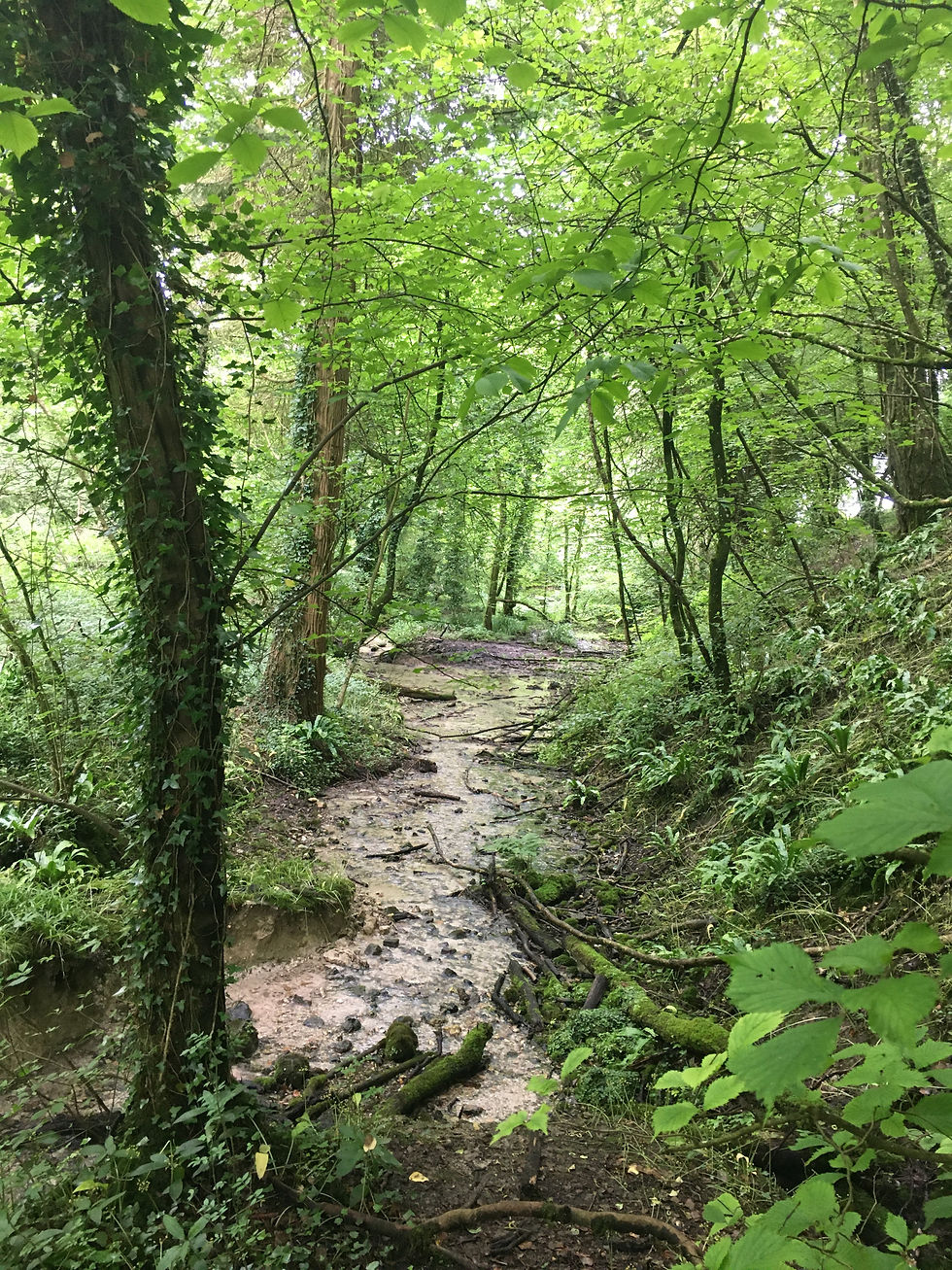
The sound of the stream haunted his sleep, he would catch its whisper on his walks on the hangers above, its murmur on a summer’s day, its harshness or ghostliness through the woods on a midwinter night.
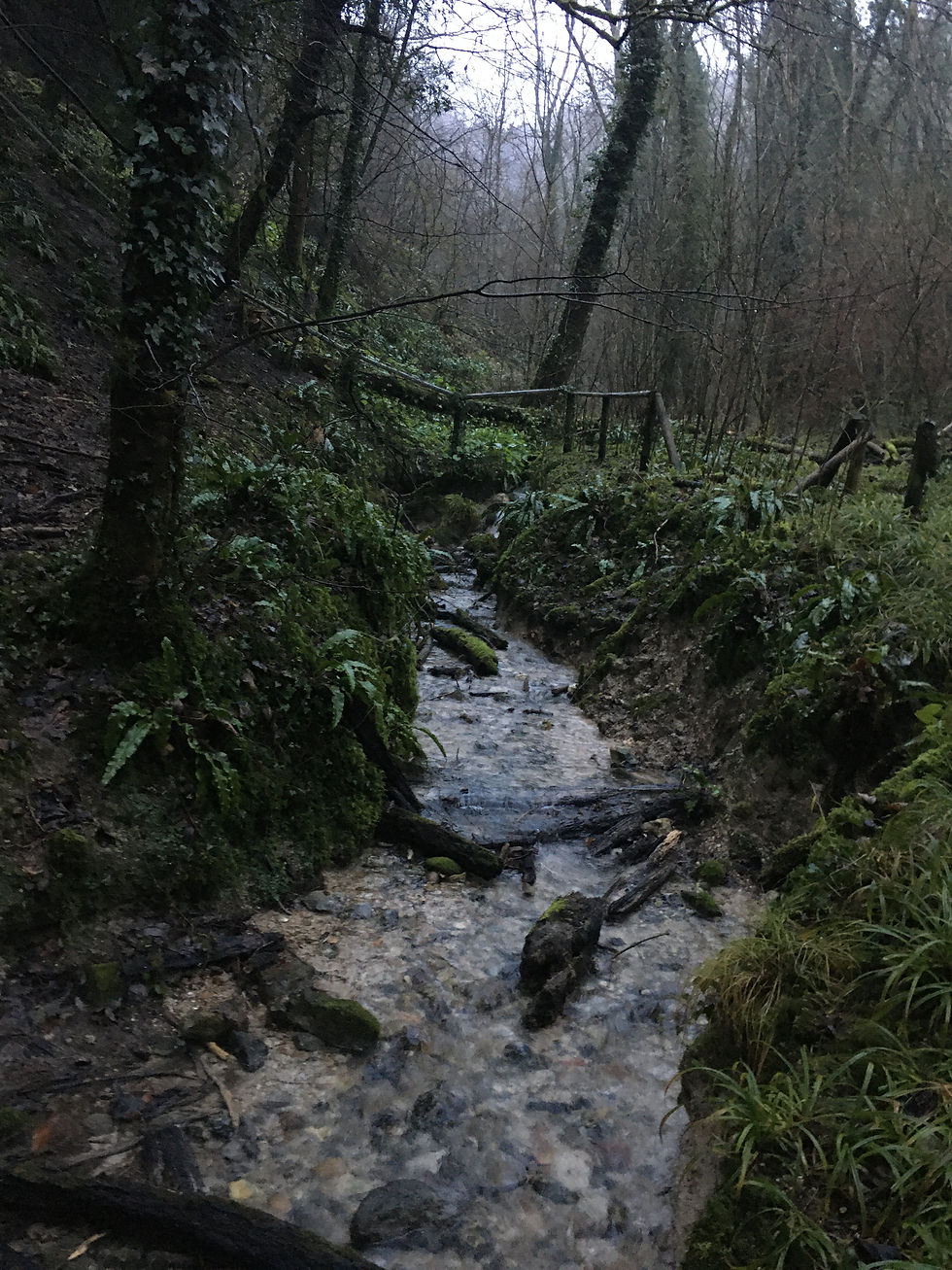
On the morning of his birthday, 3rd March, 1909, a snowy day, at home, he wrote an extended passage possibly about the mill fall itself:
“All snowy & still - the beeches spectral grey white, but yews & detached trees dazzling & pure white. A grey mist hangs with uneven edge over snowy hills - waterfall’s shaggy green sides steaming & beflowered with long icicles. The sky grey, tending to white, & the white slowly rolling away to show blue - the sun is pale & no bigger than moon. No sound but laugh of dab chick & fall of water. Black stream, its white reflections of banks etc begin to steam in sun. The fair then shadows over the glittering snow & the brilliant umbellifence. Crystal & pearl icicles, hanging on twigs, bob in breath of waterfall. Beauty of great grey oaks network outlined in snow against the clear deep blue in the now dazzling sun.”
At night the sound of the mill water was of a different order. The most similar experience that ET had encountered, can be found in his description of the sea on the south coast of Cornwall on a visit to Looe and Fowey in May 1909:
“Sea
"An endless forest of overarching sound
"All night the windy & rainy noise of sea in darkness that expounds so well the invisible scene, the plunge forward this flap, flicker & leap of foam. Silence is forgot. This is a new world— a world of sound & agst a background of sound is carved a sliding pattern of other sounds coming in & out. No sky, then the sound a continuous restless bluster which the ear longs to find some cadence in or else to end.”
The soundscape that ET conjured up from the old mill race at night approached the bluster of the sea, but silence was not forgot. Instead silentness here has the sound of the mill fall as its one companion, adding more texture and depth to the listener’s experience.

The mill fall now sounded different to when the mill was functioning, with its more ordered noise. He would never have heard this at Steep Mill but he was aware of the sound from other working mills. Most recently the year before he had visited Trotton and Treyford on the Rother, a few miles from Petersfield on the Midhurst road. There he had noted at the Mill House, its floodgates, one “rumbling foam that does not drown the dove’s croon in big aspen by mill house or the starlings’ anxious chatter or the thunder overhead…” He recalled the event in one of his earliest poems, The Mill-Pond, and its “plunge of waters cool” through which thunder, starlings, the dove, and the girl’s warning could be heard.

In contrast at night the Mill-Stream submerged these sounds, a free for all, now “The music of the mill-wheel’s roar” has ended.
Many years before he wrote the poem, when he had first come to Steep, he had responded to the beautiful curve and bank of Ashford Stream further downstream in Steep Marsh:
“16 v 07
“Looking at bright water running & rippling round a curved steep sand bank at Steep Marsh I thought it was pity that men had so long lived on this earth & not learnt these
idioms of waters & winds among the leaves.”
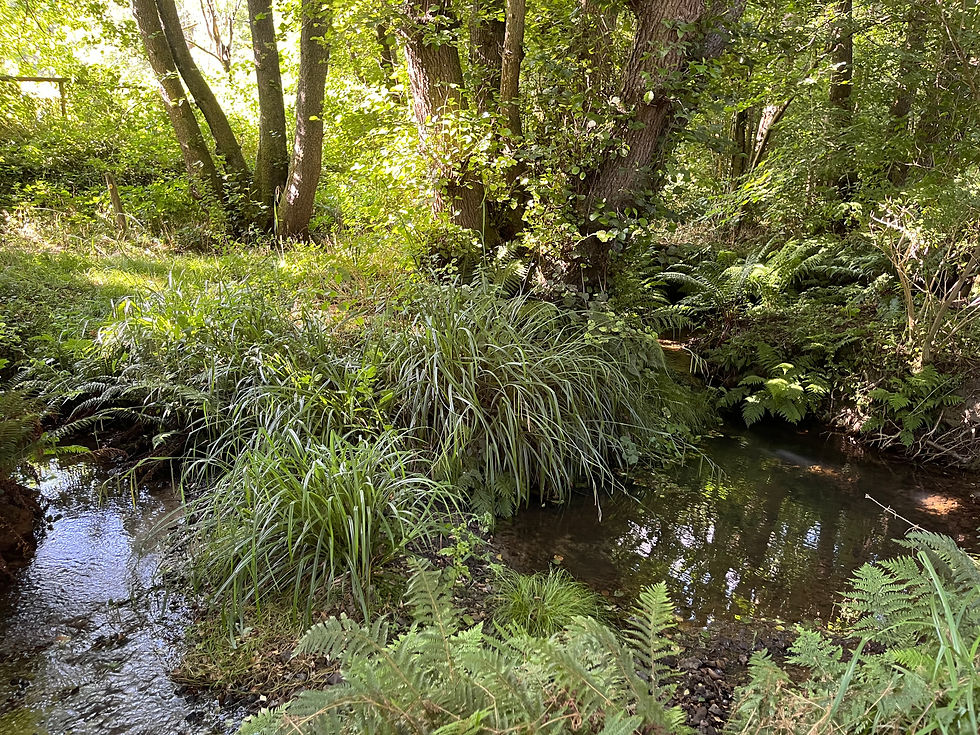
Eight years later ET had learned something of these idioms, at least in their effect on him, the listener. He had also found in his poetry a way to write about them. So it is fitting that two of his last poem written at Steep, should provide responses to one of the earliest notes he made at Steep - The Mill-Water describing the idiom of waters and Aspens on the idiom of winds among the leaves.
A walk

The Mill Water can still be seen and heard at the bottom of Mill Lane on the lane out of Steep up towards Ashford Hangers. Instead of falling straight down as in the post card of the time, it now falls at a slant as calcium deposits have built over the years.
A footpath starts at its base and takes you up steps over the streams and then to the left along the right hand bank where the old mill pond lay, towards Berryfield and the foot of Shoulder of Mutton Hill. This was a path that ET and his family would have used regularly in their time at the house - throughout the day and also on walks back home at night or on his night wanderings when he would have first heard the full majesty of the Mill Water.
Sadly with the increase in ambient noise there is little chance of hearing the fall from the distances ET could around the parish. The path continues through woodland and then on to a drive. When you reach Ashford Lane you go left along to Ashford Manor and then follow the track by the side of the stream up to Ludcombe Pond and continuing beyond it to the source of the stream at the near end of Ludcombe Bottom, close to the site of old Ludcombe Cottage, which sat immediately under the hangers.
The path is on the Hangers Way. Either you can continue following the Way up the hanger taking a right which will eventually take you to the top of the Shoulder of Mutton - or you can explore the hangers at a lower levels taking paths either to left or right before, and returning to the lane by Ashford Manor. If you go right along Ashford Lane you can complete a circuit from the Mill Fall by taking the lane to the left between Byways and Island Farm. At the bottom of this you go left again to get back to the Mill Fall, slanting out, in endless sound and motion.

As the Mill Water concentrates the volume, power and sound of Ashford Stream at one point, so ET’s love for Ashford stream was concentrated into this elegiac poem. He neevr wrote another poem about this much=loved stream. The Mill-Water was not only a summary of these memories of his time at Steep, and a fond farewell to Ashford Stream, but also a commemoration of a rural England that was changing, accelerated by the War. Like Two Houses, The Mill-Water was also a memorialisation of the history of the parish and his village antecedents, now past or passing, brought into sharper relief for Thomas, as he was preparing to go off to fight with all that that entailed.
There is a black and white drawing of Steep Mill below the hangers in the Hampshire Record office, based on the painting of Steep Mill (above) which appeared in a magazine about Steep in the 1890s. Underneath it has the following description of the Mill and its surroundings, very different in its style from ET’s but in its way as appreciative of the countryside around as he always was.
“Steep Mill is a typical little Homestead of the picturesque County of Hampshire, and is situatel by a small lane that winds its way between and over the knolls that form a foreground to the higher and well wooded hills that run from east to west along the Northern Boundary of the Parish.
“The wheel is turned by the fresh and clear brook that rises in that most beautiful English Glen, known as Ashford Glen, rushing with its abundant supply of crystalline water, over the boulders and round the declivities, to the Mill Dam, half lined with spruce and other conifers, after which it turns the wheel, and speeds onward through a more level and pasture land valley.
“Whether Steep Mill be hung with icicles in Winter, or shaded by the rich foliage in Summer, it is always a pleasing specimen of an old Hampshire Mill, where, in the carly Spring, the stillness of a country life is only broken by the melodious voices of the nightingale and other song birds, and the country round about is brightened by numerous wild flowers indigenous to Steep and the surroundings.”

Acknowledgements
Edward Thomas Field Note Books copyright Henry W. and Albert A. Berg Collection, New York.
Transcription of the Edward Thomas Field Note Books quoted in this and other posts are available at the Edward Thomas Centre in the Petersfield Museum.
My thanks to Fran Box, previously of Steep History Group and now keeper of the Steep History Archive for all her help and the fascinating information about Steep Mill and its surroundings. The painting of Steep Mill and the post card of Mill Lane are reproduced with kind permission of Fran and the Steep History Archive. They are not to be reproduced without permission - for more information contact: franboxsteep@yahoo.co.uk
The post card of the Mill Water is reproduced with kind permission of Kit Claxton-Wright and my thanks to her for allowing me to photograph around the old Mill Pond.
My thanks to Benedict Mackay for editorial support.


Comments