The Brook

Seated once by a brook, watching a child
Chiefly that paddled, I was thus beguiled.
Mellow the blackbird sang and sharp the thrush
Not far off in the oak and hazel brush,
Unseen. There was a scent like honeycomb
From mugwort dull. And down upon the dome
Of the stone the cart-horse kicks against so oft
A butterfly alighted. From aloft
He took the heat of the sun, and from below.
On the hot stone he perched contented so,
As if never a cart would pass again
That way; as if I were the last of men
And he the first of insects to have earth
And sun together and to know their worth.
I was divided between him and the gleam,
The motion, and the voices, of the stream,
The waters running frizzled over gravel,
That never vanish and for ever travel.
A grey flycatcher silent on a fence
And I sat as if we had been there since
The horseman and the horse lying beneath
The fir-tree-covered barrow on the heath,
The horseman and the horse with silver shoes,
Galloped the downs last. All that I could lose
I lost. And then the child’s voice raised the dead.
‘No one’s been here before’ was what she said
And what if felt, yet never should have found
A word for, while I gathered sight and sound.

Edward Thomas wrote The Brook in July 1915 as his time at Steep was drawing to a close, a few weeks before he was to join up.
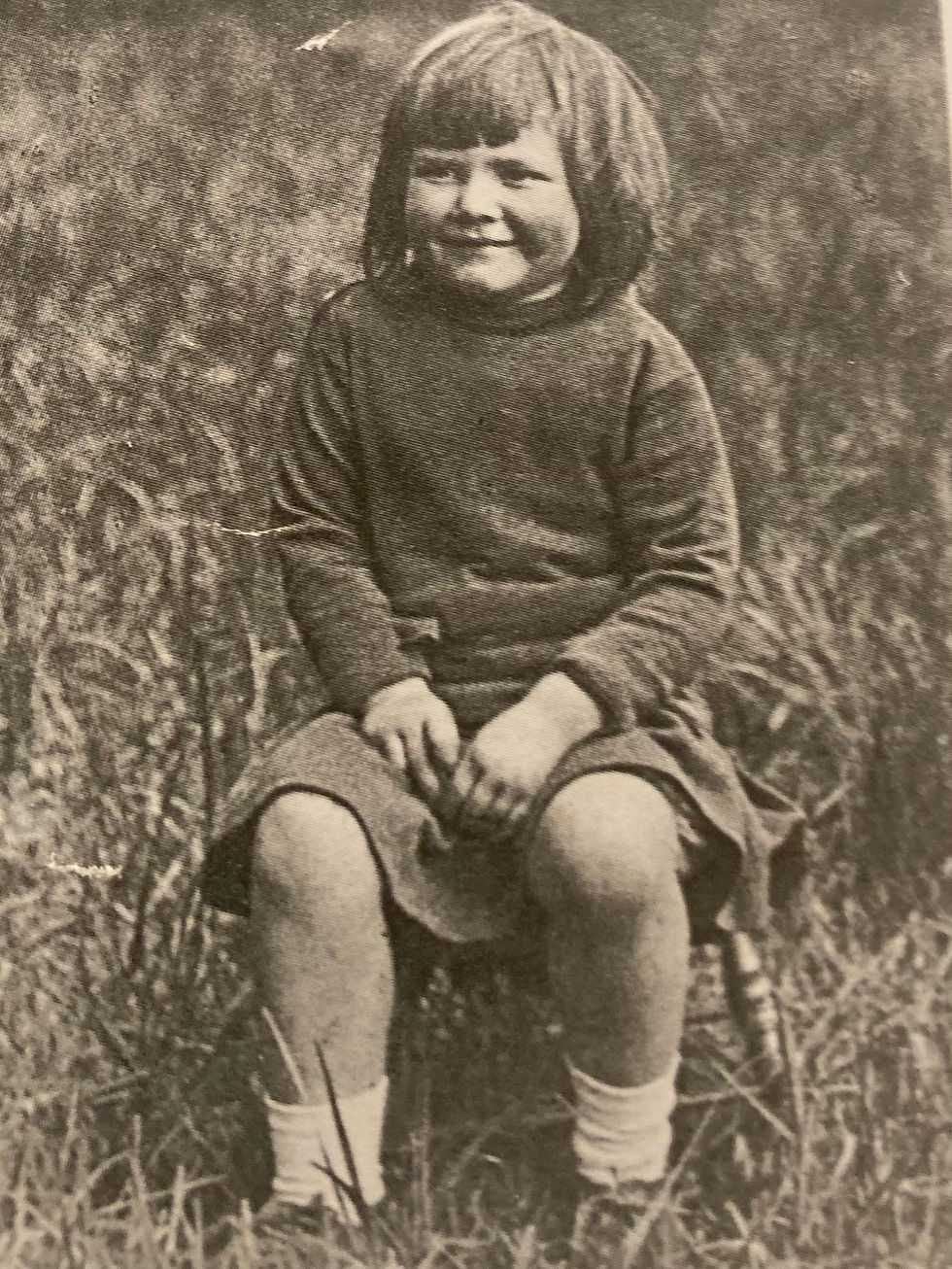
The child who speaks so simply but profoundly was Myfanwy, his younger daughter, and she remembered clearly the scene of the brook in her memoirs, which contains this lovely passage:
“In my mind’s eye it is high summer and very still and I see the site as though I were a kestrel questing above it. Green slopes of short turf are either side of the stream, where my father sits reading and smoking his clay, perhaps writing in his notebook. Not far from here I am paddling in the swift shallow water is an arched stone bridge. There is a sharp pain in the soles of my bare feet, which look greenish in the stippled water. It is very still and serene as I scramble out of the stream and join my father; he rubs my feet, crinkled and cold. We sit there quietly and the silence is intense and I have that strange certainty and excitement that only comes only once or twice in a lifetime, which I share - ‘No one’s been here before.’”
The walk may have taken place earlier in the summer of 1915, possibly in June, or it may have been another summer. That said in the summer 1915 Myfanwy would have been nearly five so her later memory would have been clearer than when younger.
Edward Thomas’s field note book of the time suggests this as well.
The poem is drawn from a number of entries in FNB 80, all written in 1915, his last notebook and one that contains ideas and outlines and drafts of a number of his poems. Some of these notes were clearly from direct observation at that time, others were drawn from previous entries. However the main event - the child in the stream - only appears in this last notebook and there is a freshness and immediacy to the observation, which suggests that this was a very recent observation, not as suggested by the poem’s “once” long before or some fairy story the poet had made up.
“Nobody’s been here before says Baba (Myfanwy’s family nickname when young) paddling in sandy brook so she thinks…”
On the page below this note are others including two more which feature in the poem - “Mellow the blackbird, tart the thrush” and “The silent/solemn? flycatcher grey on the fence”.

On the following page appears a note dated 2nd June 1915,
“The smell like honeycomb of mugwort dull.
& Brown hair, brown as a thrush or as a nut
The frizzled water over small stones.”
There is no confirmation in the notebook where the stream is. However there is much stronger evidence where the horseman with the horse with silver shoes can be found. On the opposite page to the above note, there are a list of six ideas for poems including two which were to appear in the Brook - the third - “The stone the cart horse kicks agst so oft” and the final one:
“not since the horseman & the horse w silver shoes that lie now in the Bramdean tumulus ceased riding on the Downs
That sleep within the barrow on the heath
Last rode on the Downs.”
So the horseman and the horse with silver shoes can be located in the Bramdean tumulus.

The tumulus that Edward Thomas was thinking about was an unusual one. By the side of the main road, in the Dean, a mile to the east of Bramdean, it was on the opposite side to some dolmens which had been set up by a local landowner, in imitation of much more ancient structures. ET had come across them first in May 1910 when he noted “then to “The Dean” where is wide grass border to Winchester Road & hollowed out for old chalk diggings (?)ET also on the turf some sarsens artificially arranged somewhat like dolmen.”

He passed the “sham” dolmens again two years later, on his way back from Alresford Fair, near the turning to Brookwood.
But he only noticed the tumulus opposite the dollowing year, when his companion seemed to have pointed it out:
“31 vii 13
Bramdean Common - faked dolmen - with firs & turf opposite hiding (?ET) tumulus
of hunter with silver shoe of horse - dolmen erected by soldiers (Edith says) -
she doesn’t know how long ago, but they have graves(?)”

The tumulus was in fact the flint burial mound certainly for one, and possibly for two horses. The first was a favourite hunter of Colonel Greenwood, a local landowner, living at Brockwood Park which was buried in 1845. A subsequent one, Melksham, belonging to Colonel Meinertzhagen, who also lived at Brookwood, died at the spot in 1911 and was supposedly buried there and was memorialised on the gravestone by its side.
The dolmens on the opposite side of the road had also been placed there by Greenwood, an inventive amateur geologist and archaeologist with a sense of humour. Various rumours of their origin quickly spread, including that they were the graves of soldiers from the nearby battle of Cheriton in the English Civil War, as Edith relayed to Thomas. But the horseman with a horse with silver shoes has never been associated with the Bramdean “monument to a horse” other than by Edward Thomas in his notebooks. Perhaps he was drawing on Celtic legend where silver horseshoes feature - he had recently written a book on the subject. Or more likely he knew of the tale from English folklore and the myth of the horse that died of exhaustion having galloped from London to Marbury in Cheshire in a single day. The trial had been undertake to win a bet for his master and the horse was buried in honour with silver shoes. ET seems to have translated this myth to Melksham and his master, Colonel Meinertzhagen.

In the poem he talked of “the fir-tree-covered barrow on the heath”. He mentioned the fir trees over the tumulus on his last journey on that road in 1913. The Heath, which some have speculated may be Petersfield Heath where many tumulus and barrows had been identified, was in fact Bramdean Heath. Thomas in referring specifically to the heath is also making a reference to the Battle of Cheriton in the Civil War, whose first phase was known as the Battle of Bramdean Heath. So he was linking fictitiously the horseman and horse in their grave to that decisive cavalry battle won by the Parliamentarians. (On one of his visits to Bramdean Common he had noted “Beyond the common, on left is broad rising open unenclosed land of grey grass to great beechwood at edge - this is all low downland - cavalry land…”)

Less certain is where the stream in which Myfanwy paddled was. A sandy brook sounds as if it was closer to home in the Hampshire hangers, either the Ashford or Oakshott streams, which have greensand bases. However there is no obvious place where this could have occurred, as described by the poet and his daughter.
Given Myfanwy’s strong memory of the event being near Bramdean and the connection ET makes in the poem between the afternoon by the stream and the horseman and his horse with silver shoes and the Bramdean tumulus, a stream close by this eccentric folly seems the most likely candidate. That said there is no stream in the immediate vicinity but there are two young streams - the Itchen and the Meon within a couple of miles or so.

We know that ET had gone with Bronwen, his elder daughter on a bike ride to beyond Warnford on the River Meon in May. Did he then take his younger daughter to another stream, probably at her behest, keen to make a similar expedition with her father as her elder sister had done?
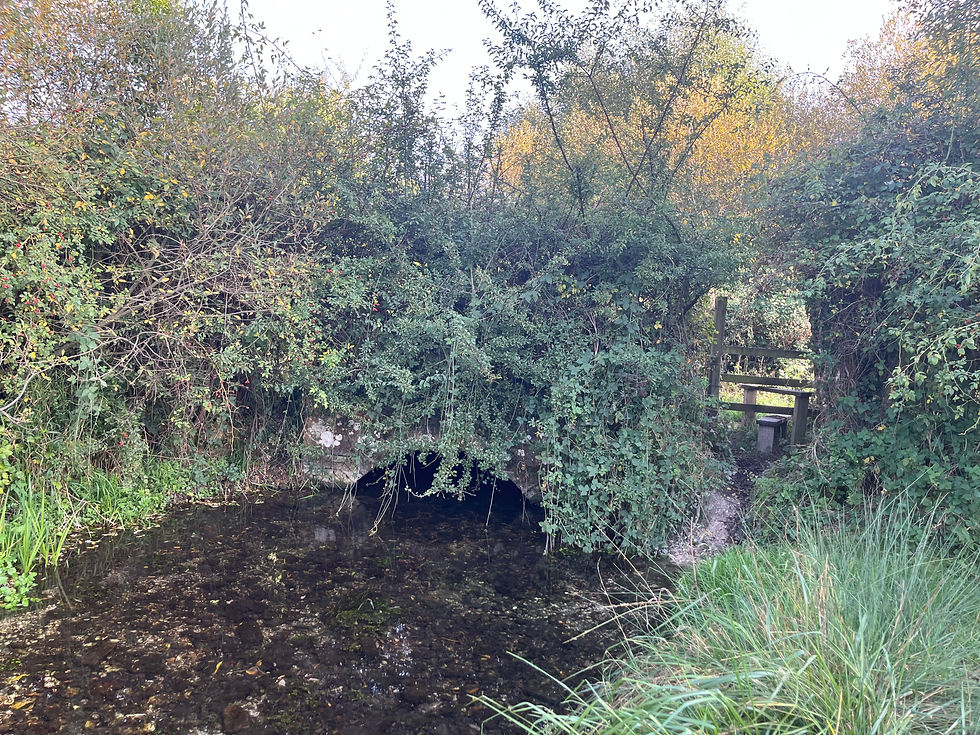
What she described could be a young girl’s view of the young Itchen between Cheriton and Tichborne, in particular at the track crossing the stream close to Sevington Farm. It’s still a beguiling place and you can see that, with a young child’s eyes, it would have appeared much as it does now: low grass slopes on either side of the shallow swift stream with stippled, frizzled water over stones in the ford where the cart-horses could cross; and in the background an arched bridge. Any sandiness in the brook could have come from where the chalk stream touched on deeper deposits of greensand.

ET had explored this area thoroughly on a number of occasions, on journeys on foot or bike to Winchester and further west. In the walk section below, there is more on one of these walks.
With all his time being spent on writing and researching his life of Duke of Marlborough, the mystery is when he would have been able to take time to take off to go on an expedition to Bramdean from Steep with his 4 year old daughter.
His letters to Robert Frost, Eleanor Farjeon and others at the time are full of the burden of Marlborough and how all days and hours were spent on it. However he wrote on 2nd June to Eleanor Farjeon that he had got back to Steep the day before after “a long train journey and a short ride from Whitchurch, a little harassed by this Marlborough deficit, but the lanes were delicious. We were all together by 8.” The “short ride” was over 30 miles even by the most direct route so it would have taken between two to three hours to get back home from the station.
It’s not clear where he was coming from - most likely he was travelling back from London specifically so he could enjoy the bike ride back along the lanes from Whitchurch to home, having taken his bike up and down on the train. The 1st June was a Tuesday so he may have been up there for the day before - he wrote a letter to Robert Frost when he got back about all the talk in London being of zeppelins. In which case he may have taken Myfanwy to London on the train, leaving her with his mother while working at the British Library, and then together catching the train back to Whitchurch on the Tuesday and riding back with her home. (His “we were all together by 8” suggests two groups meeting rather than him joining the family.)

The most direct route using lanes back from Whitchurch in North Hampshire to Steep in the East Hampshire hangers would have taken him past Tichborne and the upper Itchen, a place that ET knew and had very much enjoyed on his first visit five years before. If so they could have stopped off by the stream close to Sevington Farm, for an hour or two in the summer afternoon sun by the Itchen, enjoying the paddle and the quiet with Thomas jotting down notes about his poetry in his notebooks. He would have then ridden past the Bramdean tumulus and dolmens on the way home.
There could be an argument that the whole poem is a construct of different events during that summer - and that he was using the Bramdean tumulus in this regard to provide historical context. However this seems unlikely with the tumulus and the stream being physically close, as well as in the poem, and in Myfanwy’s remembrance.

There is however one aspect of the poem that does seem to have been drawn from a different time. In July of the previous year (1914), he had been walking on Stoner Hill, his normal route between his study and home, when he had come across a butterfly. He wrote:
“The Painted Lady came to scabious blossom but when my shade frightens her she was content with a hot flint stone. I, like the butterfly, when I leave view & bushes & have only shaded road.”
In contrast to the butterfly he preferred the shady road to the sun-heated stone
Earlier that morning he had seen many meadow browns by Cold Corner at the top of Stoner Hill, on bramble flowers, and disturbed by the bees, settling instead on the road in dry grit.
He compared their behaviour to a “family of children newly come to a house they like in a strange village which they don’t yet know the ways of & disregard as yet..”
He went on: “So sunny & warm here & the air astir with the drabbish butterflies.”
He goes on to ponder: “Why don’t I pause longer; because I should realise beauty is all, in going on, in life, & can only be touched as it passes - & is beginning to pass when you know it is joy & beauty.”
So nearly a year later he again seems to have been presented with an outstanding opportunity to savour the present - and this time had taken it - and found his younger daughter encapsulating it with her words.
A Walk

There is a good walk that passes by the spot on the young Itchen where Edward Thomas and his daughter may have spent that idyllic time. Edward Thomas himself did one leg of the walk between Cheriton and Tichborne in August 1910. He walked along the windy shallow river one perfect evening “with narrow levels one either side of lush thistly grass with goldfinches…willows & white poplars. On one side land rises fairly steep to beech crowned or tonsured hill & with Tichborne & Cheriton churches on slight eminences - pasture on steeper bank, but on some of the high land is cut oats which lies beautifully open to the late sun & the pale blue with white wisps. The short stubble glimmers & a few small saved poppies show among the rising clover - swallows sing & fly as if very glad - it is now perfect weather - on levels by Tichborne some huge thick elms. Good farms with millions of nettles by roadside. Good cottages at Tichborne & one small unpretending Tichborne Arms. The wisps increase & almost cover sky with ostrich feathers by 7.30, sun setting w’out colour. “

ET was walking along the footpath on the bank of the Itchen, which you can still do. A good loop can be done by parking on the Hill House Lane which is the second turning to the left as you head south through Cheriton, after Brandy Mount where the Cheriton Potts pub can be found. Parking on the lane, you walk up to Hill Houses and follow the track to the right which takes you up on your the downs above the river. This path then goes through several fields until it becomes a track taking you down to Sevington Farm. Over the lane there is a farm track which crosses the river after a couple of hundred yards - this is the place where ET and Myfanwy stopped that summer afternoon.

On the other side of the river, the track gets to a T junction. Take the right hand track . and walk up to the Cheriton-Tichborne Road. You turn right and then almost immediately right again into the lane to Sevington Farm and then left on to the path through Cheriton Mill and along the banks of the Itchen, in the opposite direction to Edward Thomas’s walk in August 1910. Through several fields you arrive back at the lane where you parked.
Edward Thomas had taken his August walk as a sort of rest cure. He had written at the end of his notes on the day of the walk, which had also encompassed Warnford and Beauworth:
“I took this walk as part of attempt to clear away the effect of all my reading etc of past 6 months - as I went along tho I enjoyed it how did it fall short of my desire - how
ashamed I was of what wd come into my mind at times - just as last night returning
home late (as a large horned moon set & all stars were clear & one shooting left a red hot stain like poker for a second or two) I look up at heavens but cd not keep my mind off trifles while I was trying to get into harmony.”
Was this walking cure in his mind when he rode his bike with Myfanwy back from Whitchurch to home as he was in the midst of his dreary task of writing the life of the Duke of Marlborough? And did he plan or decide on the spur of the moment to stop off at a remembered lovely spot on the walk he had undertaken five years before to idle a couple of hours away and dwell in the moment, avoiding trivial thuights, while appreciating the beauty all around.
Acknowledgements
Edward Thomas field note book copyright - Henry W. and Albert A. Berg Collection, New York. Transcriptions of the Edward Thomas field note books quoted in this post are available at the Edward Thomas Centre at the Petersfield Museum.


Comments